mit der H2-Sling zu beweisen, dass Wasserstoff in der Luftfahrt eine sinnvolle und umsetzbare Alternative zu herkömmlichen Treibstoffen ist.
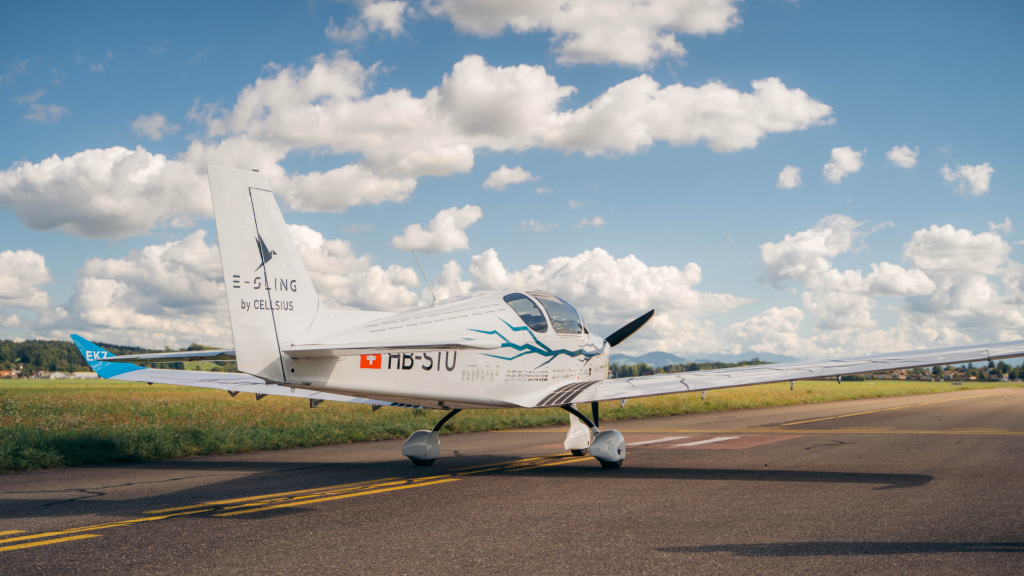
While developing the s-Sling we had already started working on creating a proof of concept. In the same year, 2022, we successfully generated electricity with a fuel cell for the first time - an important milestone, marking the beginning of developing and sampling a 100kW hydrogen powertrain.

We focus on the development of the system as a whole rather than on individual components. We take existing, proved components and rearrange them in a way that hasn't been done by anybody before. Not only the system design but also the structural integration into our carrier plane as well as safety are in the centre of our attention.

Mit dem geplanten Erstflug im 2026 streben wir an, das erste wasserstoffbetriebene Flugzeug der Schweiz – und sogar das weltweit erste von Studierenden gebaute Wasserstoffflugzeug – zu werden. Doch unser Ziel geht über den reinen Machbarkeitsnachweis hinaus: Mit einem späteren Flug über die Alpen wollen wir auch die Praxistauglichkeit und Leistungsfähigkeit unseres Antriebsstrangs unter Beweis stellen!
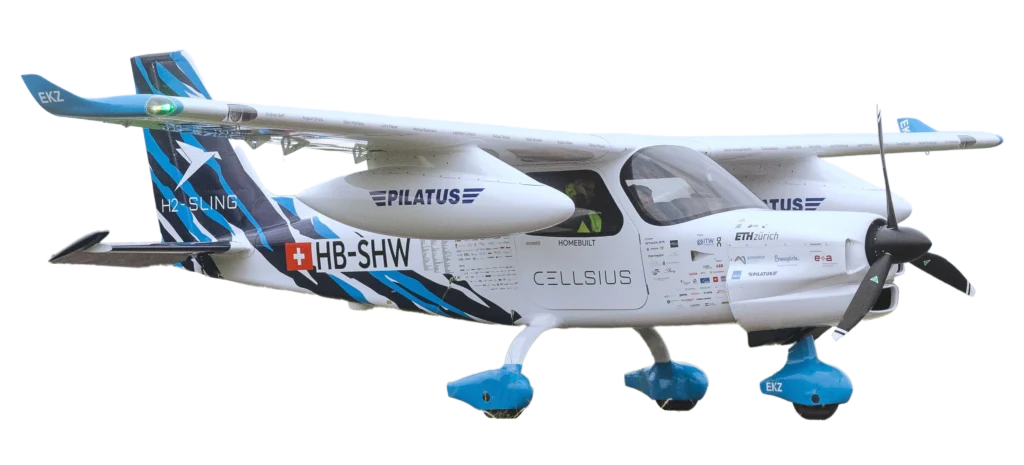
Die H2-Sling wird von einem leistungsstarken 100-kW-Brennstoffzellensystem angetrieben. Dieses wandelt gasförmigen Wasserstoff zusammen mit dem Sauerstoff in der Luft zu elektrischer Energie und Wärme um. Dabei entsteht als einziges Nebenprodukt reines Wasser – vollkommen emissionsfrei. Dank der hohen Energiedichte des Wasserstoffs bietet die H₂-Sling zudem eine beeindruckende Reichweite, die neue Maßstäbe in Sachen nachhaltige Mobilität setzt.
Emissions
Range
Flight time



Fuel cell system
The fuel cell system of the H₂-Sling is based on a fuel cell of the company PowerCell. In the fuel cell an electrochemical reaction takes place between the oxygen in the air and the infused hydrogen. This sets a lot of energy free in form of electricity but also heat.
Several subsystems are essential for this reaction to be performed flawlessly, ensuring an efficient and trouble-free operation. The subsystems provide a precise controlling of the reaction, optimal cooling, and a reliable supply of hydrogen and oxygen.
Fuel cell system
Different compression strokes make up the high-pressure gas system that supplies the fuel cell with hydrogen. To ensure a stable and efficient chemical reaction, the fuel cell is supplied with more hydrogen than actually needed. The excess, unused hydrogen is returned to the supply circuit and reused. This recirculation significantly increases the efficiency of the system.
Fuel cell system
Additionally to hydrogen, oxygen is required for the chemical reaction in the fuel cell. We use our cathode cycle to elaborately preprocess the ambient air from which we then extract the needed oxygen. By doing so we actively regulate the air pressure, mass flow, humidity, and temperature - in every moment of the flight. This ensures optimal operating conditions for the fuel cell and maximises efficiency and performance.
Fuel cell system
The fuel cell has an efficiency of about 50%, meaning that with 100kW electrical energy an additional 100kW heat is produced. Especially in aviation an efficient usage and abstraction of this heat is a big challenge. A well designed thermo management is therefore crucial to ensure a stable operating temperature at every time.
Safety
In our project we work with high pressures, hydrogen, high voltage systems, and a various number of mechanical hazards on a daily basis. Especially when in combination, a proper handling of and expertise on these matters is essential. Therefore, safety is always our number one priority - during development, testing and later in the airplane itself. We set up strict safety protocols and mechanism, and complete certified trainings to reduce the risk of an incident to the very minimum at all times.
Safety
Hydrogen is one of the most reactive substances that can create an explosive compound when combined with air. We have developed strict safety concepts, meeting the highest safety standards to ensure a safe handling at any time. Additionally, all our hydrogen system engineers are educated according to the current safety standards by our partner ITW-Schindler.
Safety
We use the "Isolé Terre" safety architecture to protect our pilot and ground crew best possible from high voltage accidents. This safety architecture prevents dangerous voltages even in case of an error, ensuring best possible safety. In addition our electrical-systems engineers are specially trained in safe working with high voltages by our partner ITW Schindler.
Safety
The authorization of an hydrogen airplane is especially challenging since there are no official formalities published yet. Hence, we've been working closely with the admission authorities for several years. This close cooperation allows us to accord our technologies with the highest standards in safety and quality.
High voltage system
High voltage systems enable an efficient transmission of energy by working with voltages of several hundred Volt. In our project we use a high voltage battery system for reliable performance in various parts of the system, such as the starting of the hydrogen system and providing additional energy for the take-off. We ensure safe and efficient operation by using safety mechanism like a battery management system (BMS) and temperature monitoring.
High voltage system
Most of the energy is generated by the hydrogen system, yet we use a high voltage battery for additional energy during the take off and to start the hydrogen system. The entire 5.6 kWh-battery package with 650 Volt nominal voltage is developed, built and tested by us. Safety and efficiency is provided by a battery management system and constant temperature monitoring.
High voltage system
Most of the energy is generated by the hydrogen system, yet we use a high voltage battery for additional energy during the take off and to start the hydrogen system. The entire 5.6 kWh-battery package with 650 Volt nominal voltage is developed, built and tested by us. Safety and efficiency is provided by a battery management system and constant temperature monitoring.
High voltage system
The H2PDU is part of the fuel cell system and connects the fuel cell with the DC/DC-converter. Thanks to built in relays the fuel cell can be disconnected from the rest of the system if needed. A too high electrical flow is prevented by built in fuses. Integrated sensors measure the electricity and tension while PCBs surveil the isolation and further safety-relevant components. Just like the HVPDU the H2PDU is developed and built by us.
High voltage system
The DC/DC transducer converts the low tension of 200V from the fuel cell to the required tension of the battery. Additionally it enables the regulation of the initial performance of the fuel cell.
Electric drive
The electrical power chain is developed completely by us. Based on the experiences from the e-sling the system is constantly improved. Many of the components are developed by us, allowing us to perfectly match the dimensions seamlessly with our system and to make them as light as possible. Together with various partners we’re at the peak of innovation; we use latest materials, smart control systems, and progressive manufacturing methods, redefining the limit of what is possible.
Electric drive
The electric motor powers the propeller with a maximum output of 100 kW (135 ps) at 2250 rotations per minute and is air cooled. We have developed, produced and tested the motor together with our partner e+a Elektromaschinen und Antriebe AG. We use simulations to optimise the mechanical and thermic layout of the body bearing and spindle.
Electric drive
The inverter transforms the direct current of the battery and fuel cell system into an alternating current to drive the motor. From system architecture, control electronics and software to the body of the inverter we develop everything by ourselves. The inverter uses Sic MOSFETs, making it very efficient, and is, just like the motor, air cooled.
Tanks
Due to its very small density gaseous hydrogen is stored with extremely high pressures. We store our hydrogen in a cylindrical type 4 hydrogen tank that is made up of carbon fiber, enabling us to store up to 2.6 kg hydrogen per tank at a pressure of 700 bar.
Tanks
Hydrogen tanks are much larger than regular fuel tanks and can therefore not be installed on the wing leading edge. Instead we developed a construction to instal them externally beneath the wings, attached to the main structure. The entire tank mounting is developed by us. All of the structural components are tested through calculations and simulations to ensure that they conform to the licensing standards, making them bear up to 600 kg of stress.
Tanks
The cowling, covering the tanks and structure, is tested via stream analysis and optimises aerodynamics. The analysis allows for forces to be simulated and the resilience to be ensured in advance. Despite its length of two meters the light fiber composite cowling only weighs a few kilograms.
Aircraft
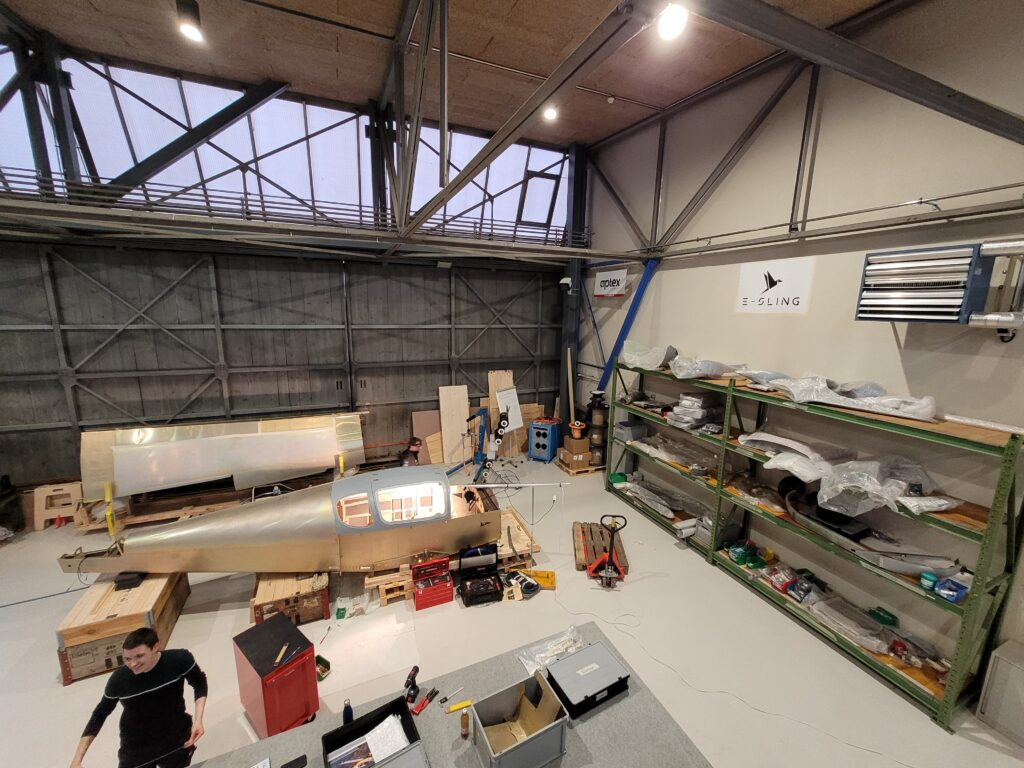
Our carrier aircraft is the Sling HighWing. It is a so-called kit aircraft meaning, we get the individual parts delivered and build the plane in our own hangar. This makes the Sling HighWing ideal for our project as it offers ideal conditions with its high payload, and allows us to implement all mechanical adjustments whilst assembling it.
Aircraft
We extended the length of the wings in order to improve flight performance. Longer wings reduce air thrust during cruise, making a longer flight time possible, and enable faster climbing and reaching of higher flight altitude. During the designing we have considered aerodynamic properties as well as structural requirements, to guarantee ideal performance and safety.
Aircraft
With the completely new dimensioning of the electrical power train the motor compartment of the H2-Sling is hard to be recognized – only the chassis stayed the same. The motor mount, motor, battery, electric component and the front cowling have been completely redesigned. The motor mount combines all the components with the structure of the aircraft and absorbs the propeller thrust. The stability of the mount is tested and validated to the point of failure through stress tests.
Aircraft
The components of the fuel cell are assembled on a specially constructed carrying structure which connects the components to each other mechanically. Six adjustable tie bars allow a precise positioning in the aircraft. The tie bars must withstand extreme strain, prevent deformation and guarantee an impeccable functioning of the fuel cell system during the flight.
Aircraft
An extensive cabling is necessary to combine the motor and inverter that are located at the front of the airplane with the fuel cell system, located at the back of the H2-Sling. The high voltage cables transmit the electricity from the fuel cell to the motor whilst the communication between the subsystems is provided by data cables. To prevent disturbances the high voltage cable and the signal cable have been separated and the cable routing thoroughly planned.
Cockpit
Our cockpit layout is based on the Dark Cockpit Philosophy that only shows alerts and warnings if the pilot needs to take action. The. Control elements, display and LED-indications are arranged in an intuitive layout to prevent unnecessary distraction. Further, any distractions were minimised, and the awareness of the situation are maximised through the logical and ergonomic design developed in collaboration with the Lufthansa Aviation Training Switzerland. Clear colour coding and a well-structured arrangement help to register critical information immediately, and to react in case of need.
Cockpit
Our Powertrain display shows all relevant data of the powertrain at one glance. Additionally to the most important information, further detailed analysis and failure indications are displayed in an overview. Clear colour coding makes critical values and warnings easily recognisable, allowing the pilot to react properly and swift even in stressful situations during flight. The PT Display has been developed specifically for a hydrogen powered airplane, focused on aviation standards.
Cockpit
Our cockpit is designed to guarantee maximal reliability. Each essential function has a backup that will take over the required tasks in case of system failure. A second, smaller display will show the most important information if the primary display fails. Additionally, a special override function allows the pilot to switch to a reduced operating mode and continue the flight safely if there should be problems with the powertrain.
Cockpit
Our avionic system is based on the Garmin G3X glass cockpit and is specially designed to allow an intuitive and efficient operation. All relevant flight data are displayed well arranged, providing the pilot with a good overview at all times. A clear structure and easy navigation allow the pilot to focus on the essential – a safe and precise flight.
Software and control electronics
In a complex system such as the powertrain of the H2-Sling, quite some control electronics and software is needed for the controlling and coordinating of all the components and for a proper reaction in case one of the components fails. We develop our own plates for the controlling and monitoring of the components. The software is made based on model-based development or on C++ code written by us.
Software and control electronics
The ECU is the central controlling unit, steering the complete system. Both the software and the hardware are developed by us. They make sure that processes, like starting the system, run properly and that in case of failure the correct reaction is initiated. Further, it delivers the desired performance by regulating the energy flow from the fuel cell system and the battery into the motor.
Software and control electronics
The FCCU is responsible for an optimal operation of the fuel cell, by controlling and regulating the components of the hydrogen system. The plate is developed by us and contains inputs for the various sensors needed, to monitor and regulate the system, as well as a feedback based regulation. Further, controlling of the components is possible through outputs on the plate. The complex software including the regulator is written by us in C++.
Software and control electronics
The DHVC is responsible for a safe operation of the high voltage system. With various switching and software units it provides for a reliable functioning of the system during the flight and ensures that at no point a person working on the aircraft is endangered.
Testing
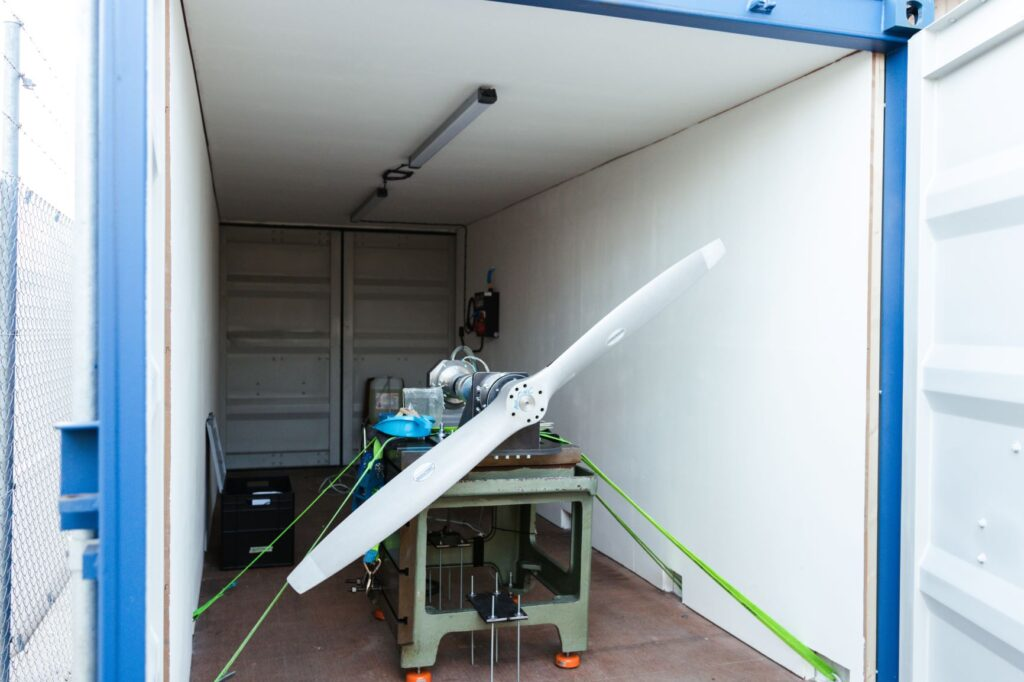
After the designing and simulations have been done on the computer our concept is iterative refined in our test stand. By running various tests we get a profound understanding of the system and gain valuable insights of its behaviour during different operating states. Further, our test stand allows us to configure and test our powertrain in the same way as it will later be installed in the aircraft. This increases efficiency and reliability of our system considerably since potential sources of failure are identified at an early stage and reduced to a minimum.
Testing
Having our test stand in Dübendorf allows extensive on site testing of the hydrogen fuel cell and tank systems. The automatic data acquisition allows a precise analysis and optimisation of all the relevant parameters. Top safety standards make testing with minimal manpower possible – an efficient and safe base for the further development of our technology.
Testing
Our high voltage test container makes realistic tests of the high voltage battery, inverter and electric motor possible. The test stand is directly connected to the hydrogen test stand, allowing us a practical testing, optimization and validation of the entire system, ensuring that all components work together in an efficient and safe way before installing them into the aircraft.
Testing
We monitor and analyze the data of running tests in real time thanks to a specially developed web-application. This application doesn’t only make real time data acquisition and monitoring during our tests possible but also later during the flight. At all times we can evaluate critical parameters of the system, identify room for improvement and provide seamless surveillance of the performance of our powertrain.
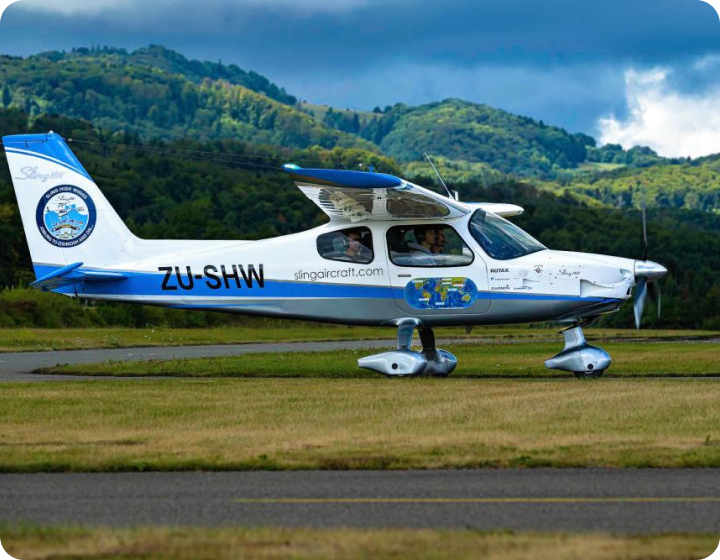
At our rollout event we could proudly present our achievements of the past two years in front of a big audience.
After two years of intensive developing and research our aircraft finally takes off from the runway in Dübendorf for the first time!
After the final validation of new components like the DC-DC transducer and the integration of various software components, the team is ready to assemble the electric powertrain back into the aircraft.
After a lot of blood and sweat the entire system has been tested successfully. The aim was to improve the electromagnetic compatibility between components and to test at a performance of 100 kW.
September 2021
In the follow up to the focus project 2021 ETH students complete the e-Sling and work on an extension of the battery package with a hydrogen fuel cell, marking the beginning of the project H2.
Over a period of 8 months 12 ETH mechanical and electrical engineering students have been working on the first e-Sling project. The project is realised in collaboration with project partners, sponsors and further support.
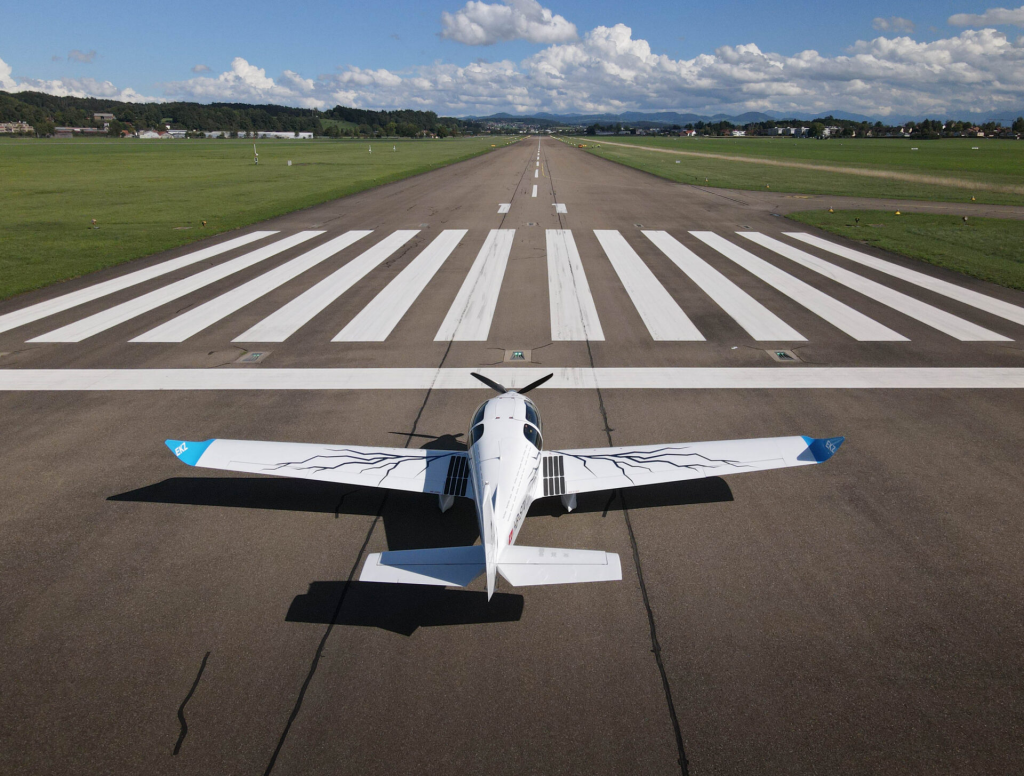
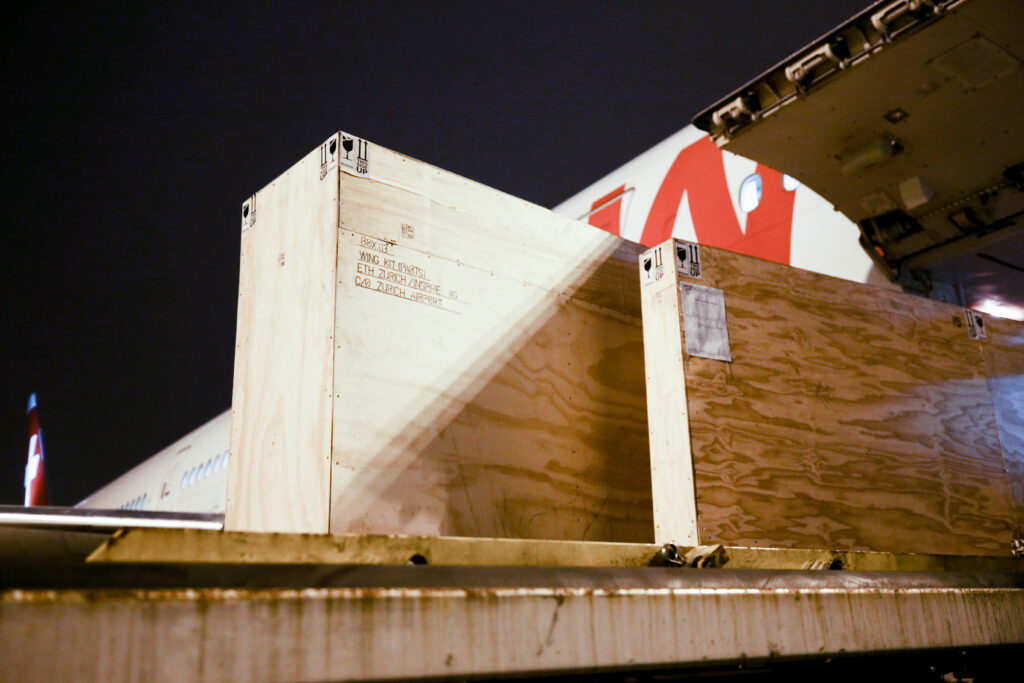
The revised aircraft structure was manufactured by Sling Aircraft and was delivered to Switzerland via air transport. At the same time the team acquired project partners and sponsors and took care of further organisational preparations for the e-Sling project.
During the preparations for the e-Sling project the 4 seated Sling TSi from Sling Aircraft has been classified as particularly suitable. The wingspan has been increased from 9.5m to 10.5m due to a higher efficiency. Alexander Weiser therefore travelled to South Africa and together with Sling Aircraft they developed the modified aircraft structure. At the same time the team was looking for partners for a potential cooperation and worked on further project frame conditions.
support us in various ways, ensuring that our dreams don’t remain mere aspirations but can be turned into reality.







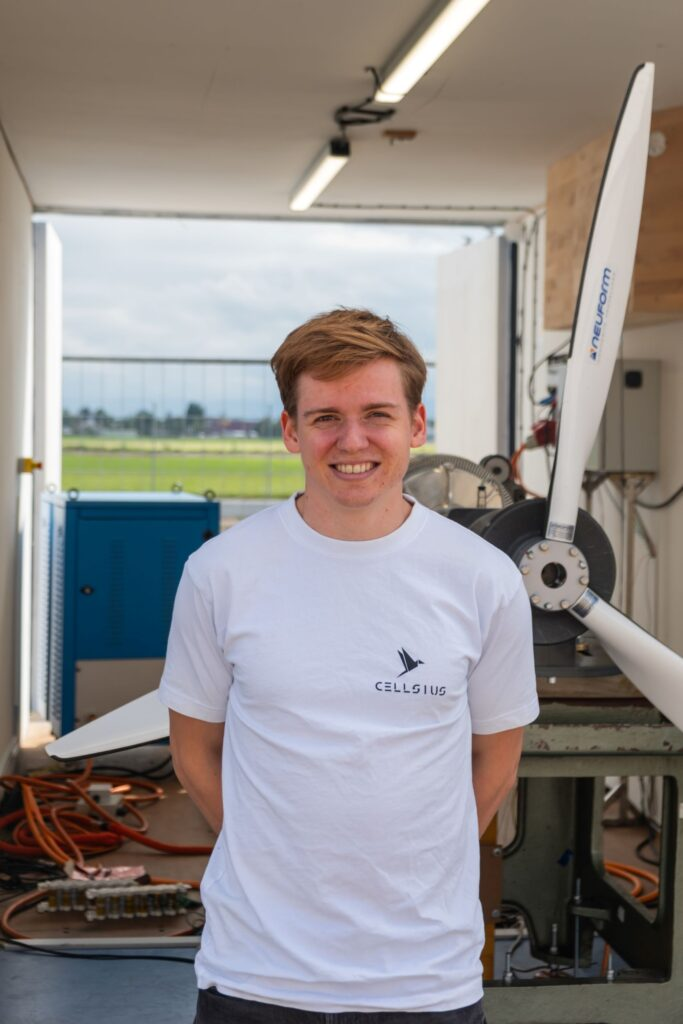
„CELLSIUS verkörpert Antoine de Saint-Exupérys Weisheit: «Wenn Du ein Schiff bauen willst, dann trommle nicht Leute zusammen, um Holz zu beschaffen, Aufgaben zu vergeben und die Arbeit einzuteilen, sondern lehre sie die Sehnsucht nach dem weiten, endlosen Meer.» Kaum je erlebte ich die Kraft einer gemeinsamen Vision stärker als im CELLSIUS Team.“
Technical Lead
Wir wollen nicht nur innovative Antriebstechnologien entwickeln, sondern auch Studierenden die Chance geben, echte Praxiserfahrungen zu sammeln und aktiv zur klimaneutralen Zukunft beizutragen.
Technical Lead
Wir wollen nicht nur innovative Antriebstechnologien entwickeln, sondern auch Studierenden die Chance geben, echte Praxiserfahrungen zu sammeln und aktiv zur klimaneutralen Zukunft beizutragen.
Technical Lead